


Araby Astley
Character Bio
Araby Astley - Reader Preview
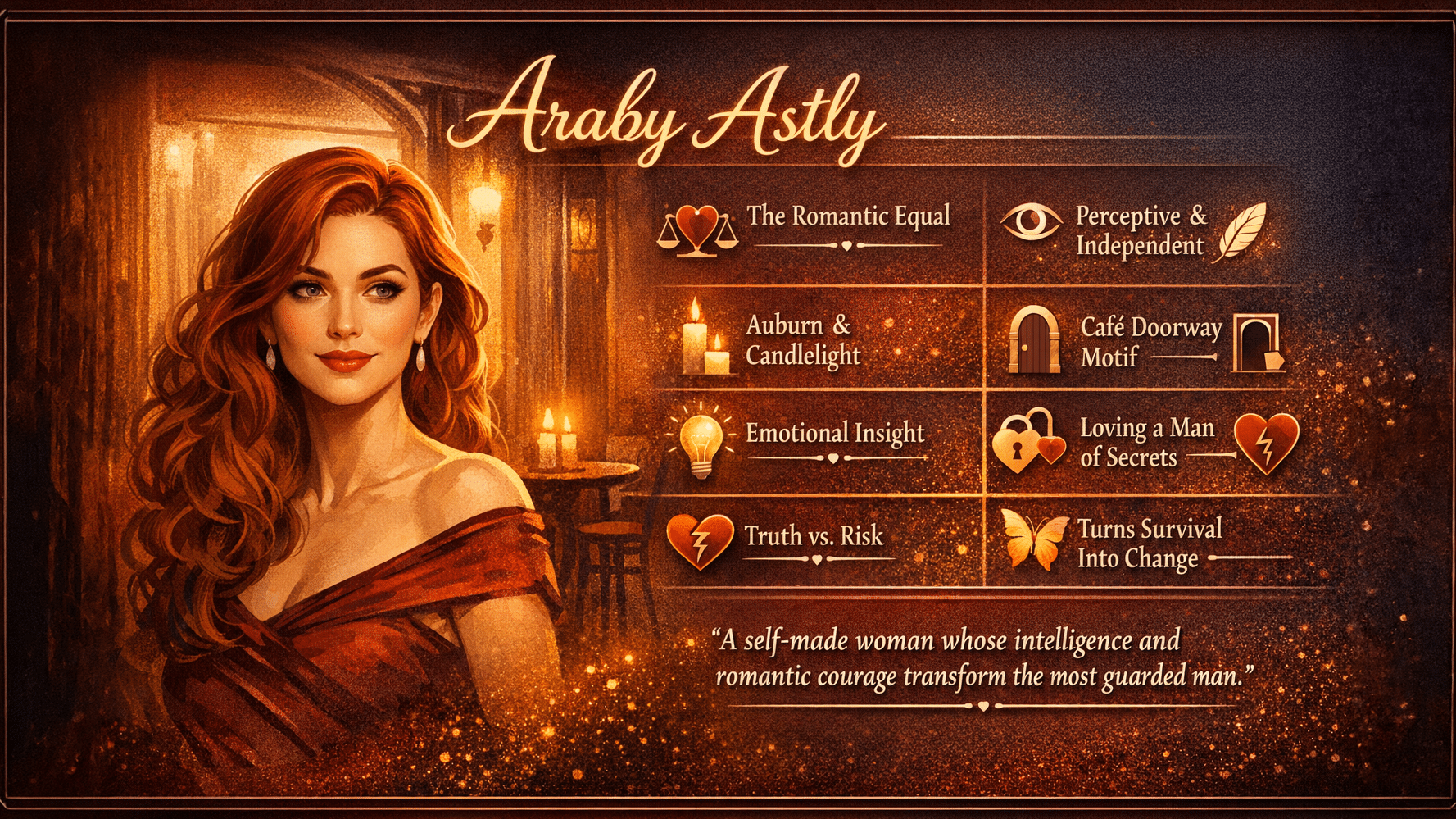
This bio explores Araby as more than a love interest: she is the novel’s emotional equalizer, romantic disruptor, and one of the few people capable of reading Dalton accurately. It focuses on her intelligence, self-possession, earned independence, and the way she forces the story’s hardest man into a more vulnerable truth.
1. Character Snapshot
| Field | Details |
|---|---|
| Full Name | Araby Astly |
| Aliases / Nicknames | Unknown |
| Story Role | Deuteragonist / Major Supporting |
| Narrative Function | Emotional catalyst, romantic equal, moral and psychological mirror for Dalton |
| Approximate Age / Life Stage | Adult; likely around Dalton’s age or somewhat younger (Inferred) |
| Occupation / Status | Small business owner / operator associated with the Sad Café |
| Residence / Setting Association | Aeroplane City; closely tied to the Sad Café |
| Canon Status | Mixed |
2. First Impression
Araby arrives with charm, poise, and a dangerous kind of intelligence: the sort that notices
what others perform and calmly steps past it. Her first major effect is not simply attraction
but destabilization. She makes Dalton feel seen in ways that are flattering, invasive, and
impossible for him to dismiss.
3. Physical Presence
Araby is remembered through impression as much as feature: long, wavy auburn hair, a distinct
scent that briefly overrides Dalton’s tactical focus, and a graceful, confident movement that
cuts through space cleanly. She carries herself with feminine sophistication rather than
fragility. Dalton’s language around her suggests beauty sharpened by intelligence; she is not
decorative on the page so much as immediately vivid.
| Visual Trait | Details |
|---|---|
| Hair | Long, wavy, auburn |
| Presence | Elegant, assured, memorable |
| Movement | Smooth, confident, knife-clean |
| Style | Sophisticated, polished, feminine |
| Voice | Warm, probing, intelligent |
4. Core Personality
- Dominant traits: perceptive, romantic, self-possessed, intelligent, emotionally articulate, quietly bold
- Strengths: insight into people; emotional courage
- Flaws: can move faster than caution permits; occasionally trusts intensity where suspicion may be warranted
- Public-facing personality: charming, witty, composed, socially graceful
- Private emotional reality: serious about risk, proud of what she built, unwilling to be patronized or reduced
Araby’s personality is striking because she combines softness of manner with firmness of will.
She understands romance, but she does not romanticize helplessness. She is capable of tenderness
without surrendering self-respect, and she resists Dalton most effectively when she refuses the
role of protected woman.
5. Inner World
Araby seems to want something rare in this world: feeling that is both sincere and adult. She is
drawn to depth, integrity, and emotional truth, which is why Dalton interests her so quickly.
At the same time, she has a strong instinct for self-protection and personal agency. Her
insecurities are less visible than Dalton’s, but her insistence that she earned her life, her
business, and her independence suggests a history of needing to be taken seriously on her own
terms. She values intelligence, earned success, romance that means something, and mutual respect.
What she may not admit immediately is that she wants not merely a fascinating man, but one brave
enough to meet her in honesty.
6. Backstory and Formation
The manuscript does not provide Araby’s full early biography, but it strongly indicates that she
built her position rather than inheriting it. She explicitly rejects the notion that her family
handed her the Sad Café or her first business, emphasizing that she earned what she has. She also
knows how to use fake virtual identities for protection, which implies a practical familiarity
with risk and a life not wholly sheltered from danger. The result is a woman whose refinement is
not naïveté; it appears to be the polished form of hard-won competence.
7. Present Situation
Araby enters Dalton’s life in Aeroplane City during a volatile stretch, when he is grieving
Baxter, under threat, and on the edge of profound personal change. She becomes emotionally
entwined with him quickly, but not passively. She is managing her own business concerns, making
independent decisions, and stepping into danger with more awareness than Dalton first assumes.
Her present situation is therefore twofold: she is both romantic possibility and a person
navigating her own stakes inside a dangerous world.
8. Motivations and Stakes
| Element | Details |
|---|---|
| External Goal | To live and love on honest terms while protecting the life she has built |
| Internal Need | To be met as an equal rather than idealized, managed, or shielded |
| Motivation | Attraction to depth, sincerity, and meaningful connection |
| Stakes | Her autonomy, emotional safety, business life, and potential future with Dalton |
| Main Obstacle | Dalton’s secrecy, the violence surrounding him, and the instability of his world |
| Self-Sabotage Pattern | Risks emotional involvement with a man whose life is structured by concealment |
9. Relationships That Define Them
| Character / Group | Relationship Type | Dynamic | Why It Matters |
|---|---|---|---|
| Dalton Vrees | Romantic counterpart | Attraction, psychological insight, mutual challenge | She changes Dalton’s arc by reopening the possibility of love and honesty |
| Sad Café / her work life | Identity anchor | Earned independence, competence, self-definition | Her work is part of her dignity and agency |
| Herself | Self-protective independence | Proud, capable, unwilling to be diminished | This is what prevents her from becoming a passive romantic object |
10. Conflict Profile
Araby does not seem to default to panic. She responds to tension with directness, clarity, and
a refusal to let other people narrate her limitations for her. Criticism likely sharpens rather
than collapses her. Affection, in her case, brings openness rather than retreat, though not
without standards. Her moral limits seem rooted in respect and self-command; she may accept
danger, but not condescension. What would push her past those limits is being lied to in ways
that make her complicit in risks she did not choose.
11. Voice and Behavioral Signature
Araby speaks with conversational elegance. She is flirtatious without being frivolous,
intelligent without pomposity, and emotionally frank without melodrama. She tends to probe
rather than lecture, and her humor often arrives wrapped around sharp perception. On the page,
she feels like a person who notices the shape of another person’s soul before they have finished
defending it. Her recurring signature is this: she makes emotional truth sound both natural and
inescapable.
12. Character Arc
Araby’s arc is less fully interiorized than Dalton’s, but her narrative movement is still
substantial. She begins as a charismatic, intriguing equal with romantic intelligence and grows
into the person who most clearly destabilizes Dalton’s old defenses. Over time, she becomes not
just an object of desire but a test of whether Dalton can live honestly. Her endpoint is
ambiguous: the novel leaves the emotional future unresolved enough that she becomes both memory
and possibility. That ambiguity is part of her power.
13. Distinguishing Contradiction
Araby feels soft in first contact but proves structurally hard to patronize. She embodies
romance while resisting every script that would make romance synonymous with weakness. She is
warm, but not naive; vulnerable, but not unguarded.
I find it hard to be a simple man.
- Lars Hindsley